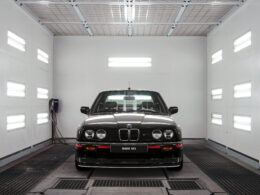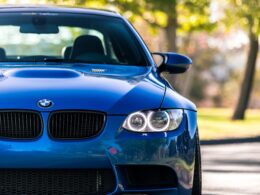




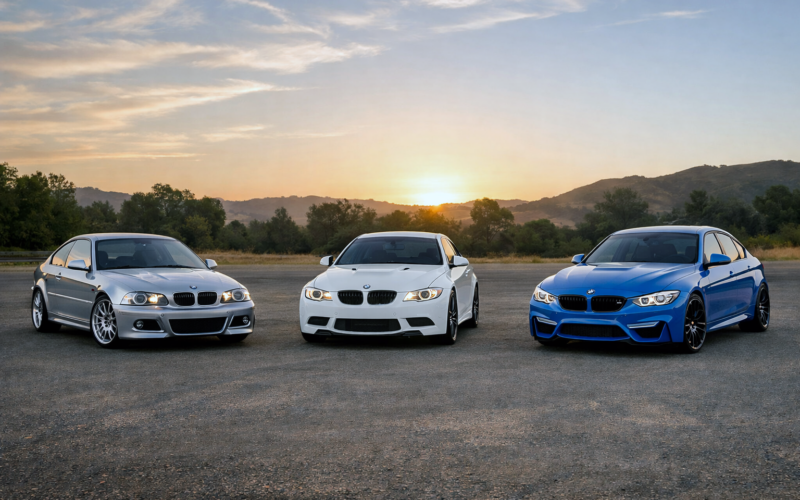
Three generations of the ultimate driving machine, three very different ownership experiences. We break down what it actually costs to keep an E46, E92, or F80 M3 on the road.
The BMW M3 has long represented the pinnacle of the sports sedan formula—a proper four-door that can embarrass dedicated sports cars on a back road while still hauling your family to dinner. But here’s the thing nobody tells you when you’re browsing classified ads at 2 AM, convincing yourself that a used M3 is a perfectly rational purchase: these cars don’t all cost the same to own, not by a long shot.
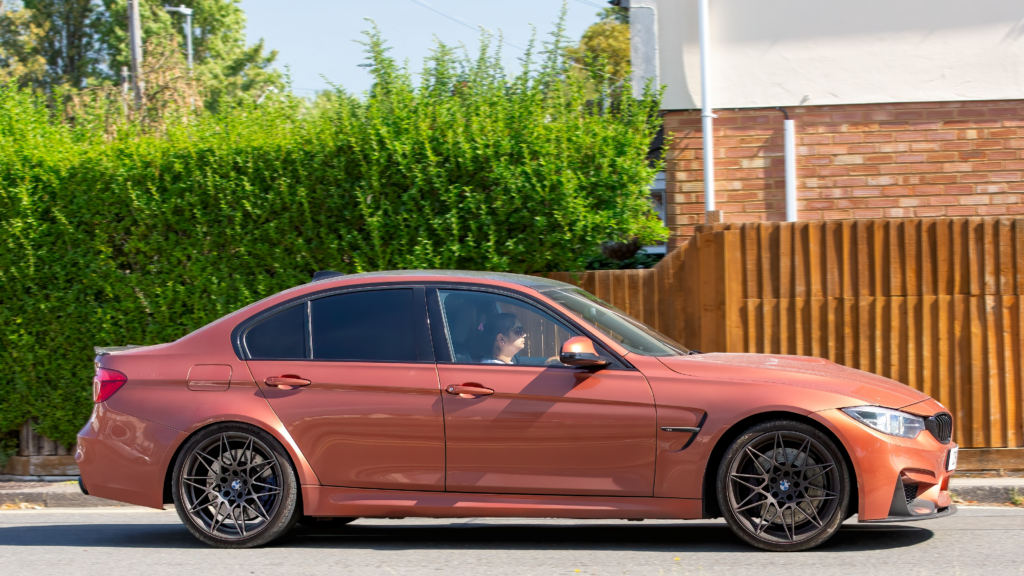
We’re talking about three distinct generations here. The E46 M3 (2001-2006), with its naturally aspirated inline-six and analog charm. The E92 M3 (2008-2013), the last of the naturally aspirated V8 M cars and arguably the most dramatic of the bunch. And the F80 M3 (2015-2020), the turbocharged newcomer that purists initially dismissed but that’s proven itself as a proper M car in its own right.
Each represents a different era of BMW M Division engineering, and each comes with its own particular flavor of financial commitment. So let’s talk real numbers—not the sanitized figures you’ll find in ownership forums where everyone claims their M3 has been “absolutely bulletproof,” but the actual costs you’ll face when you sign up for M3 ownership in 2024.
The Purchase Price Reality Check
Let’s start with what you’ll actually pay to get into one of these cars today. The E46 M3, once the affordable entry point into M3 ownership, has been climbing steadily. Clean examples with reasonable mileage—we’re talking 80,000 to 120,000 miles—now command between $25,000 and $35,000. The days of the $15,000 E46 M3 are largely over, unless you’re willing to take on a project car with deferred maintenance that’ll cost you that savings and then some.
The E92 M3 occupies the middle ground, with good examples ranging from $35,000 to $50,000 depending on mileage and specification. The coupe commands a premium over the sedan, and if you want the rare six-speed manual transmission, add another $5,000 to $10,000 to those figures. The market has recognized what enthusiasts knew all along: the E92 represents the end of an era, and that naturally aspirated V8 isn’t getting any more common.
The F80 M3, being the newest of the bunch, starts around $45,000 for higher-mileage examples and can stretch past $60,000 for low-mileage Competition Package cars. The good news is that F80 prices have stabilized after their initial depreciation hit, and you’re buying a car that’s still within its design life rather than one that’s approaching classic status.
But the purchase price is just the entry fee. The real question is what happens after you hand over the check.
Insurance: The Monthly Reality
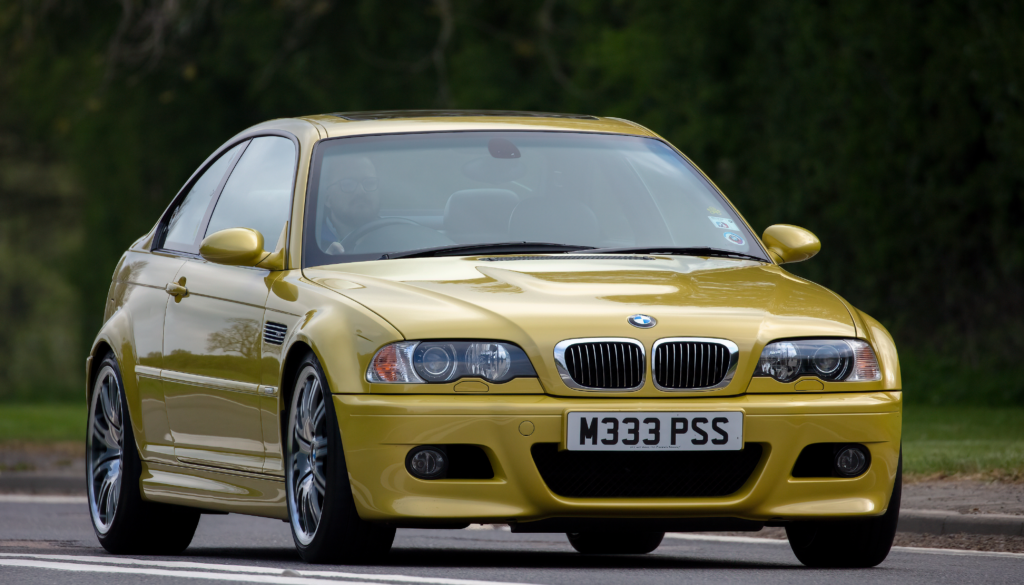
Insurance costs vary wildly based on your age, location, and driving record, but M3s aren’t cheap to insure regardless of generation. The E46 M3, despite being the oldest, still carries performance car insurance rates. Expect to pay between $1,800 and $2,500 annually for full coverage with reasonable deductibles. The car’s age works against you here—insurers know that E46 M3s are often driven enthusiastically by younger buyers, and the actuarial tables reflect that reality.
The E92 M3 is the most expensive to insure of the three, with annual premiums typically running $2,200 to $3,200. That V8 and the car’s reputation for attracting speeding tickets don’t help. Neither does the fact that repair costs for the E92 can be eye-watering when things go wrong.
Surprisingly, the F80 M3 often comes in slightly cheaper than the E92, with annual insurance costs between $2,000 and $2,800. Modern safety features and the car’s newer status work in your favor here, even though it’s the most powerful of the three.
Fuel Costs: The Price of Performance
None of these cars are fuel-sippers, but there are meaningful differences. The E46 M3’s 3.2-liter inline-six returns EPA ratings of 16 mpg city and 23 mpg highway. In real-world mixed driving, expect around 18 mpg. With premium fuel required and current gas prices, you’re looking at roughly $2,800 to $3,200 annually if you drive 12,000 miles per year.
The E92 M3’s 4.0-liter V8 is thirstier, rated at 14 mpg city and 20 mpg highway. Real-world driving typically yields 16 mpg combined, and that V8 drinks premium fuel with enthusiasm. Annual fuel costs for 12,000 miles run approximately $3,400 to $3,800. That extra displacement and those eight cylinders come with a price at the pump.
The F80 M3’s twin-turbocharged 3.0-liter inline-six is the most efficient of the bunch, achieving EPA ratings of 17 mpg city and 25 mpg highway. Real-world combined mileage of 19-20 mpg is achievable, bringing annual fuel costs down to around $2,600 to $3,000 for 12,000 miles. Turbocharging has its advantages, and fuel economy is one of them.
Maintenance: Where Things Get Interesting
Here’s where the ownership experience diverges dramatically. The E46 M3 is the simplest of the three mechanically, but it’s also the oldest, which means you’re dealing with 18-to-23-year-old components. Oil changes require 8 quarts of premium synthetic oil and a quality filter, running $120 to $150 if you do it yourself, $200 to $250 at an independent shop. BMW recommends oil changes every 15,000 miles, but anyone who actually cares about their S54 engine does them every 5,000 to 7,500 miles.
The E46’s inspection I and II services, which BMW recommends at specific intervals, run $500 to $800 and $1,200 to $1,800 respectively at independent shops. Brake fluid should be flushed every two years ($150 to $200), coolant every three years ($200 to $300), and the differential fluid every 30,000 to 50,000 miles ($150 to $200).
The E92 M3 is more complex and more expensive to maintain. That V8 holds 9 quarts of oil, and oil changes run $150 to $180 DIY, $250 to $300 at a shop. The inspection services are pricier too: $600 to $1,000 for inspection I, $1,500 to $2,200 for inspection II. The E92 also introduced more electronic systems that require periodic software updates and diagnostics.
The F80 M3 is the most modern and, surprisingly, can be the most reasonable to maintain if nothing goes wrong. Oil changes are similar in cost to the E92, running $150 to $180 DIY or $250 to $300 at a shop. The inspection services are comparable: $600 to $1,000 for inspection I, $1,500 to $2,200 for inspection II. The advantage is that the F80’s components are newer and less likely to need replacement in the near term.
Annual maintenance costs, assuming you’re staying on top of everything and nothing major breaks, run approximately $1,500 to $2,000 for the E46, $1,800 to $2,500 for the E92, and $1,600 to $2,200 for the F80.
The Big Ticket Items: What Keeps M3 Owners Up at Night
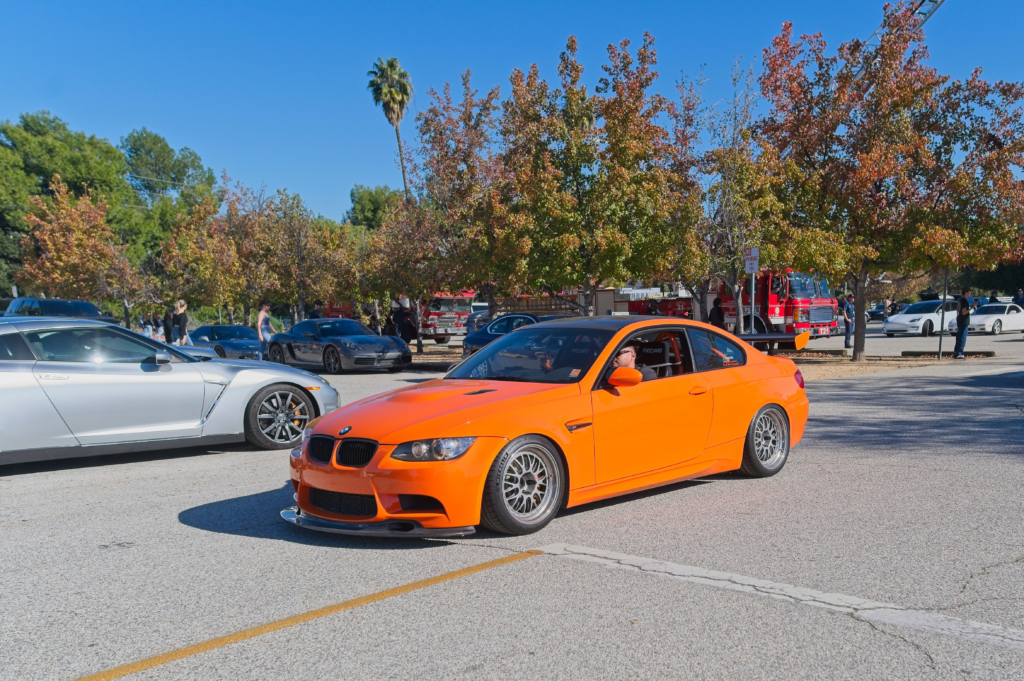
This is where M3 ownership gets real. Every generation has its particular expensive failure points, and you need to budget for them.
The E46 M3’s S54 engine is generally robust, but it has its issues. Rod bearings are the big one—they can fail catastrophically, and preventive replacement runs $2,500 to $3,500 at a specialist. Most experts recommend doing this service around 80,000 to 100,000 miles if there’s no service history. The VANOS system (BMW’s variable valve timing) can also fail, requiring a $1,500 to $2,500 rebuild. The subframe can crack where it mounts to the chassis, a repair that costs $2,000 to $3,500 depending on severity. The SMG transmission, if you have one, will eventually need a pump replacement ($1,200 to $1,800) and accumulator service ($400 to $600).
The E92 M3 has its own special concerns. Throttle actuators fail with alarming regularity, and you have eight of them—one per cylinder. Replacement costs $4,000 to $6,000 for all eight at a shop, and it’s not a matter of if but when. Rod bearings are also a concern, with preventive replacement running $3,000 to $4,500. The DCT transmission is generally reliable but requires fluid changes every 30,000 to 50,000 miles at $500 to $700 per service. When it does fail, you’re looking at $5,000 to $8,000 for a rebuild or replacement.
The F80 M3 is newer, so the long-term failure points aren’t as well documented, but we’re starting to see patterns. The S55 engine’s crank hub can fail, requiring a $3,000 to $4,500 repair. The DCT transmission needs the same regular fluid changes as the E92, and failures are similarly expensive. Turbochargers are generally holding up well, but when they do fail, you’re looking at $3,000 to $5,000 per turbo for replacement.
Tires and Brakes: The Consumables That Hurt
All three M3s wear staggered tire setups with wide, sticky rubber that doesn’t come cheap. The E46 M3 typically runs 225/45R18 fronts and 255/40R18 rears. A set of quality performance tires—Michelin Pilot Sport 4S, Continental ExtremeContact Sport, or similar—runs $1,200 to $1,500 installed. Expect to replace them every 15,000 to 25,000 miles depending on driving style.
The E92 M3 wears even wider rubber: 265/40R18 fronts and 285/35R18 rears on base cars, or 265/35R19 fronts and 285/30R19 rears on Competition Package cars. A set of tires runs $1,400 to $1,800 for 18-inch wheels, $1,600 to $2,000 for 19-inch wheels. Tire life is similar to the E46, maybe slightly shorter if you’re using the car’s performance regularly.
The F80 M3 runs 265/35R19 fronts and 285/30R19 rears as standard, with 275/35R19 fronts and 285/30R20 rears on Competition Package cars. Tire costs are $1,600 to $2,000 for standard wheels, $1,800 to $2,200 for Competition Package wheels. The F80’s additional power means tire life can be as short as 12,000 to 20,000 miles if you’re enthusiastic with the throttle.
Brakes are similarly expensive across all three generations. The E46 M3’s brake pads and rotors run $800 to $1,200 for the front, $600 to $900 for the rear, using quality aftermarket parts. Figure on replacing fronts every 30,000 to 40,000 miles, rears every 50,000 to 60,000 miles.
The E92 M3’s larger brakes cost more: $1,000 to $1,500 for front pads and rotors, $800 to $1,200 for rears. Replacement intervals are similar to the E46.
The F80 M3’s brakes are the most expensive, running $1,200 to $1,800 for fronts, $1,000 to $1,400 for rears. If you have the optional carbon ceramic brakes, congratulations—your pads cost $1,500 to $2,000 per axle, but your rotors should last the life of the car. Unless you crack one on a track day, in which case you’re looking at $5,000 to $7,000 per rotor. This is why most people avoid the carbon ceramic option on used cars.
The Annual Ownership Cost Reality
Let’s add it all up for a typical year of M3 ownership, assuming 12,000 miles of driving and no major component failures:
E46 M3 Annual Costs (estimated):
- Insurance: $2,150
- Fuel: $3,000
- Maintenance: $1,750
- Tires (amortized): $600
- Brakes (amortized): $450
- Total: $7,950
E92 M3 Annual Costs (estimated):
- Insurance: $2,700
- Fuel: $3,600
- Maintenance: $2,150
- Tires (amortized): $750
- Brakes (amortized): $550
- Total: $9,750
F80 M3 Annual Costs (estimated):
- Insurance: $2,400
- Fuel: $2,800
- Maintenance: $1,900
- Tires (amortized): $800
- Brakes (amortized): $600
- Total: $8,500
These figures don’t include the big-ticket preventive maintenance items or repairs. For a more realistic picture, add $1,500 to $2,500 annually to your E46 budget for eventual rod bearings, VANOS, and subframe work. Add $2,000 to $3,000 annually to your E92 budget for throttle actuators and rod bearings. Add $1,000 to $2,000 annually to your F80 budget for potential crank hub and turbocharger issues.
So the real annual ownership costs look more like:
- E46 M3: $9,450 to $10,450
- E92 M3: $11,750 to $12,750
- F80 M3: $9,500 to $10,500
The Depreciation Factor
Here’s where things get interesting. The E46 M3 has largely bottomed out in terms of depreciation. Clean, well-maintained examples are actually appreciating slightly, particularly manual transmission coupes. You might even make money when you sell, assuming you don’t rack up huge mileage or defer maintenance.
The E92 M3 is still depreciating, but slowly. You’ll lose maybe $2,000 to $4,000 per year in value, less if you have a manual transmission. The market has recognized these cars as future collectibles, which is slowing their depreciation curve.
The F80 M3 is depreciating more quickly, losing $3,000 to $5,000 per year in value. It’s still within its normal depreciation cycle, and it’ll be several more years before values stabilize. The good news is that the rate of depreciation is slowing as the cars age out of their steepest depreciation period.
The Specialist Factor
One cost that’s hard to quantify but absolutely critical: access to a good independent BMW specialist. Dealer service rates for M3s are eye-watering—$200 to $250 per hour is common. A good independent specialist will charge $120 to $160 per hour and actually understand these cars better than most dealer technicians.
Finding a good specialist can save you thousands of dollars annually. They’ll know the common failure points, have the right diagnostic tools, and can source quality aftermarket parts that are just as good as OEM but cost significantly less. They’ll also be honest about what actually needs to be done versus what BMW’s service schedule says should be done.
Budget time to find this person before you buy your M3. Join local BMW forums, attend Cars and Coffee events, ask around. The right specialist is worth their weight in gold.
The Track Day Consideration
If you’re planning to track your M3—and let’s be honest, that’s part of the appeal—add another layer of costs. Track day entry fees run $200 to $500 per event. You’ll go through brake pads and tires faster. You’ll need more frequent oil changes. And there’s always the risk of expensive mechanical failures or, worse, crash damage.
The E46 M3 is the cheapest to track because parts are relatively affordable and the car is simple enough that you can fix most issues yourself. The E92 M3 is expensive to track because everything costs more and the car is harder on consumables. The F80 M3 is somewhere in between, but the turbocharged engine means you need to be more careful about heat management and oil temperatures.
Figure on adding $2,000 to $4,000 annually to your budget if you’re doing four to six track days per year, more if you’re really pushing hard.
The Modification Temptation
It’s almost impossible to own an M3 without wanting to modify it. Exhaust systems, suspension upgrades, wheels, ECU tunes—the aftermarket for all three generations is extensive and expensive.
A quality exhaust system runs $1,500 to $3,000. Coilovers or quality suspension upgrades cost $2,000 to $4,000 installed. A set of lightweight wheels with tires runs $3,000 to $5,000. An ECU tune costs $500 to $1,500 depending on the generation and tuner.
The E46 M3 has the most mature aftermarket, with options at every price point. The E92 M3’s aftermarket is extensive but expensive—that V8 doesn’t give up power easily without forced induction, which is a $10,000+ proposition. The F80 M3 responds brilliantly to tuning, with ECU tunes adding 50 to 100 horsepower for relatively little money, but the turbocharged engine means you need to be more careful about reliability.
Resist the modification temptation, at least initially. Get to know the car in stock form first. You might find it’s plenty fast enough, and every dollar you don’t spend on modifications is a dollar you can put toward maintenance and repairs.
The Opportunity Cost
Here’s the uncomfortable truth: the money you spend keeping an M3 on the road could buy you a lot of other things. That $10,000 to $12,000 annual ownership cost could cover payments on a new Toyota GR86 or Mazda MX-5, both of which would be cheaper to own and nearly as fun to drive. It could fund a serious vacation. It could go into your retirement account.
But here’s the thing—if you’re reading this article, you’re not cross-shopping M3s with sensible alternatives. You want the M3 experience: the sound of the S54 at 8,000 rpm, or the V8’s wail at redline, or the turbocharged thrust of the S55. You want the steering feel, the chassis balance, the sense that you’re driving something special.
The question isn’t whether an M3 makes financial sense. It doesn’t, not really. The question is whether the experience is worth the cost to you personally.
The Verdict: Which M3 Makes the Most Sense?
If you’re looking purely at ownership costs, the E46 M3 and F80 M3 are roughly equivalent, with the E46 having a slight edge if you can find one that’s already had its major preventive maintenance done. The E92 M3 is the most expensive to own, but it’s also the most special—that V8 is never coming back, and the market knows it.
The E46 M3 makes sense if you want the analog experience, don’t mind wrenching on your own car, and can find a clean example with good service history. It’s the purist’s choice, and values are stable or even appreciating.
The E92 M3 makes sense if you want the most dramatic M3 experience and can afford the higher ownership costs. That V8 is worth the premium, and manual transmission examples are already becoming collectible.
The F80 M3 makes sense if you want modern performance and technology with reasonable ownership costs. It’s the fastest of the three, the most refined, and the most practical for daily driving. It’s also the newest, which means fewer immediate repairs.
Whichever generation you choose, go in with your eyes open. Budget conservatively, find a good specialist, and maintain the car properly. An M3 that’s been well cared for is a joy to own. An M3 that’s been neglected is a financial nightmare.
The BMW M3 has earned its reputation as the ultimate sports sedan through decades of excellence. But that excellence comes with a price, and it’s not just the purchase price. Factor in the real ownership costs, make sure you can afford them comfortably, and then enjoy one of the finest driving machines ever created.
Just maybe set aside an extra $2,000 in your emergency fund. You know, just in case.